
Psychiatrist and psychotherapist Dr Arzu Dalmış: “We need to make those who have experienced earthquake trauma feel that they are not alone.”
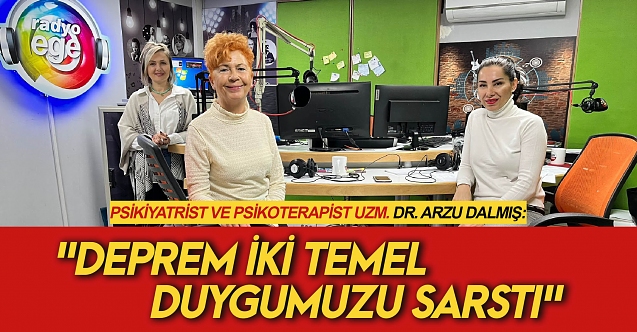
Psychiatrist and psychotherapist Specialist Dr. Arzu Dalmış: “Those who have experienced earthquake trauma must be made to feel that they are not alone”
In the program “Her İşin Başı Sağlık,” prepared in collaboration with Radio Ege and the İzmir Medical Chamber, guest psychiatrist and psychotherapist Specialist Dr. Arzu Dalmış emphasized that consolation phrases such as “be glad you are alive” are not an appropriate approach for earthquake survivors.
The main topic of the program “Her İşin Başı Sağlık,” broadcast every Tuesday at 11:00 on Radio Ege in collaboration with the İzmir Medical Chamber, was how to heal the psychological damage caused by earthquakes. The program, moderated by Assoc. Prof. Dr. Nilgün Yener and Ayşegül Koç, hosted psychiatrist and psychotherapist Specialist Dr. Arzu Dalmış.
Pointing out that everyone has experienced a major trauma, Dalmış said that earthquakes shook two fundamental emotions: the sense of basic trust and the sense of control. She reminded that earthquakes are natural events that destroy people’s basic sense of trust in the world, adding that those who experience the earthquake suffer primary trauma, while those who witness it experience secondary trauma.
Here are the key highlights from psychiatrist and psychotherapist Specialist Dr. Arzu Dalmış’s statements:
MY PATIENTS STARTED SAYING “IS OUR PROBLEM EVEN A REAL PROBLEM?”
People who experienced the earthquake, due to what they witnessed, the failure of aid reaching its destination, and their experiences in hospitals, are going through not only primary trauma but also secondary trauma. After the earthquake, my appointments were canceled for the first and second day. From the third day onward, those who came started saying, “Is our problem even a real problem? People are dealing with much worse things.”
PUTTING TOGETHER THE PIECES OF A PUZZLE
Imagine a puzzle scattered, with many pieces lost. We are trying to put those pieces back together. We need to accept the reality of the earthquake and gain the ability to manage it. Life continues, and we must open new doors to it.
REACTIONS IN THE FIRST MONTH ARE NORMAL
For about one month, all reactions are considered normal. People repeatedly relive the moment of the earthquake. Self-blame and attempts to review the past are expected reactions. Sleep disturbances and insomnia occur. Startling at sudden sounds, difficulty concentrating, being easily frightened, depressive states, and feelings of “Where am I?” are normal responses to such an extraordinary event. If these symptoms last longer than one month, psychiatric treatment may be needed.
YOU MUST MAKE THEM FEEL THEY ARE NOT ALONE
The first thing to do is prevent the continuation of trauma. Basic needs such as shelter and food must be met first. Our initial step should be first aid for emotional wounds. Then, the person should be allowed to express their feelings and tell their story as much as they want, without being forced. We must make them feel that they are not alone. Children may struggle to express themselves verbally, so helping them through drawing can be useful. These negative emotions are not easy to carry, and the mind tends to use denial as a defense mechanism.
CONSOLATION PHRASES ARE NOT CORRECT
Ninety percent of those who experience this trauma will overcome it, although their reactions to loss will differ. The Psychiatric Association has established many support centers. The first step is listening and showing that their emotions are understood. Consolation phrases are incorrect. Approaches like “Be glad you are alive, don’t cry” are wrong because the person may feel guilty for surviving and think, “I should have died instead.”
AVOIDANCE BEHAVIORS MAY OCCUR
We need to help reorganize the scattered pieces of the puzzle. Avoidance behaviors may appear, such as fear of enclosed spaces or inability to sleep without lights. These should be gradually addressed step by step.
SAYING “IT IS DIVINE WILL” MEANS SHIFTING RESPONSIBILITY
Normalizing the situation is necessary, but it is often misunderstood. Saying “it is divine will” can mean shifting responsibility away from oneself. We will cope with guilt by engaging in helping behaviors.
DO NOT CONSTANTLY WATCH EARTHQUAKE NEWS
Although something negative has happened, it is important not to remain constantly exposed to negativity. Children who are continuously exposed to news and images may feel helpless. It is enough to check the news briefly. Making children feel they are not alone is the most effective approach. Preparing an earthquake emergency bag together with a child can also be helpful.
THE EARTHQUAKE SHOULD NOT CONTROL YOU, YOU SHOULD CONTROL THE EARTHQUAKE
A person may try to cope by using alcohol, drugs, or prescription medications, but although these provide temporary relief, the problem continues. Communication is very powerful, and making sense of events and organizing them in the mind is crucial. Not everyone needs to see a therapist; talking to someone who understands you is also very important. The earthquake should not control you; you should control the earthquake.